Meet Pangram 3.3!
Pangram 3.3 improves recall on humanized and paraphrased AI text while pushing our false positive rate on ESL writing even lower.

Bugfix: On May 18, 2026, we shipped a bugfix as Pangram 3.3.2. Users may notice changes in a small (<3%) percentage of predictions, but the overall performance of the model is improved.
Note: On May 15, 2026, we shipped a minor update to Pangram 3.3. This version, Pangram 3.3.1, replaces Pangram 3.3 in all of our products. The underlying model is the same for both Pangram 3.3 and 3.3.1. The only difference is in the algorithm we use to segment longer documents. Only documents of over 450 words will be affected by this change.
Today, we’re releasing Pangram 3.3. Like previous models in the Pangram 3 series, Pangram 3.3 is based on the EditLens architecture we presented in our ICLR 2026 paper.
View Pangram 3.3's model card here
What to Expect
In the last few weeks, you may have noticed that some text from the latest OpenAI and Anthropic releases has been incorrectly flagged as human. For this update, we focused on reducing our false negative rate, or the rate at which a model incorrectly labels AI-generated text as human, on content written by these newly released models.
As always, we are committed to maintaining our industry-leading false positive rate. We will never release a model that reduces our overall false negative rate at the cost of misclassifying more human-written text as AI-generated. You should see no increase in false positives with Pangram 3.3.
In addition to improving the false negative rate for models like Claude 4.7 and GPT 5.4+, Pangram 3.3 also has better performance on humanized text, long-form documents, and ESL writing benchmarks.
What's Improved
Detection of latest LLMs
Pangram 3.3 is much better than its predecessor at detecting pure outputs from the latest generation of LLMs, including Claude 4.7, GPT 5.4+. In our internal evaluations, we see a 3x improvement for detection of GPT-5.5 Pro generated text and more than a 4x improvement for Claude Opus 4.7 compared to Pangram 3.2.
Further improvement on humanizer detection
Pangram 3.3 shows marked improvement on humanizer evaluations, catching twice as many commercially humanized texts as its predecessor. Pangram 3.3 is also better at catching adversarially prompted LLM outputs, where users instruct the LLM to evade detection: we observed a 3x improvement on our internal adversarial dataset over the previous Pangram model.
Long document recall
Our previous model sometimes misclassified longer AI-generated documents (over 2000 words) as mixed, in particular mislabeling segments toward the end of the text as fully human. Pangram 3.3 significantly reduces this classification error for long, synthetic texts.
What's Next
AI translation detection
While our overall false positive rate has decreased due to improvements in challenging domains like poetry, we observed a slight uptick in the false positive rate for human-written text that has been passed through Google Translate. We know that translation is a popular use case for LLMs, and we are experimenting with ways to both model and report results for AI-translated text in future models.
Improved identification of AI-assistance
Agent use has exploded over the last six months. We're beginning to see human-AI writing processes evolve into a collaborative model, where multiple rounds of iteration entangle human-written and AI-generated text within a document. A major focus of ours is improving our modeling of this kind of co-written document. We’re excited to build on EditLens, in order to bring you the most accurate results on mixed-author text, as well as to enable users to understand what it means for text to be “lightly” versus “moderately” AI-assisted.
Model Card
As with our previous two models, you can always check out the current model’s performance on different domains and datasets in our model card.

Katherine Thai is the Founding AI Research Scientist at Pangram Labs, an AI detection startup. She completed her PhD in Computer Science under the supervision of Mohit Iyyer at the University of Massachusetts Amherst in December 2025, where her work was focused on evaluating LLMs on tasks related to literary analysis.
Related reading
Pangram's AI Detector demonstrates strong performance in over 20 languages

Pangram Text AI Detector is now multilingual!
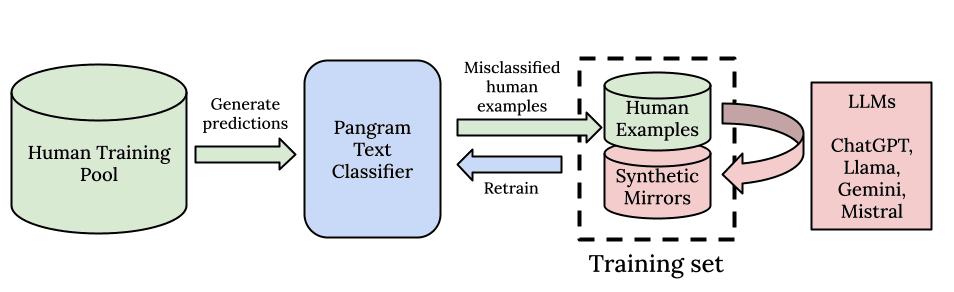
Technical Report on High Accuracy AI-generated Text Detection

Pangram 4 Migration Guide
What is a humanizer?

New Pangram Product Tiers