AI detection as a teaching tool
AI detector for teachers & educators
Uphold academic integrity with the most accurate AI detection for education. See AI use transparently, uphold academic integrity, and protect institutional reputation with 99.98% accuracy.

FERPA compliant. SOC 2 Type 2 certified. Built by AI researchers from Google, Tesla, and Stanford.
& Teachers Worldwide




Become a Pangram Education Ambassador
Get paid to help teachers navigate AI in the classroom
Join Pangram's community of educators helping teachers navigate AI in the classroom with greater accuracy and transparency.
Why Pangram
Stop guessing.
Grade with certainty.
No More False Accusations
Pangram's Hard Negative Mining technology ensures legitimate student writing isn't flagged as AI. With a false positive rate of 1 in 10,000, you can grade with confidence — not doubt.
View "Mixed" Authorship
Not every assignment is 100% AI or 100% human. Pangram highlights exactly which sentences were AI-generated vs. human-written, so you can see the full picture before starting a conversation.
Built-in Plagiarism Checker
Check for both AI-generated content and traditional plagiarism in a single scan. Get source links for matching text alongside AI detection scores.
Our tools
Everything you need
to verify authorship
From AI detection to plagiarism checking, Pangram gives teachers a complete toolkit for maintaining academic integrity.
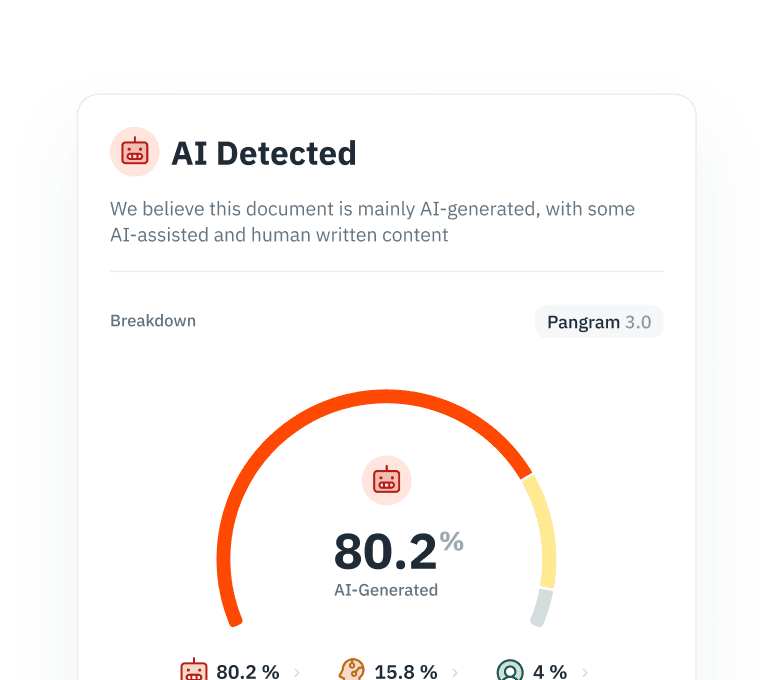
AI Segment Analysis
See a sentence-by-sentence breakdown of AI vs. human authorship. Understand exactly where a student used AI and where they did the thinking themselves.
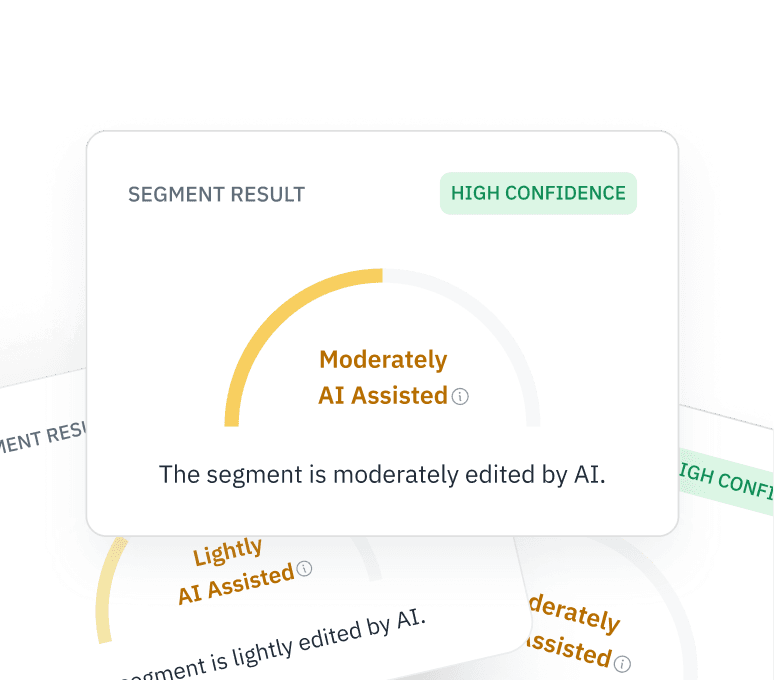
AI Assistance Detection
Distinguish between fully AI-generated text and AI-assisted writing. Know whether a student used ChatGPT to write the essay or just to polish grammar.
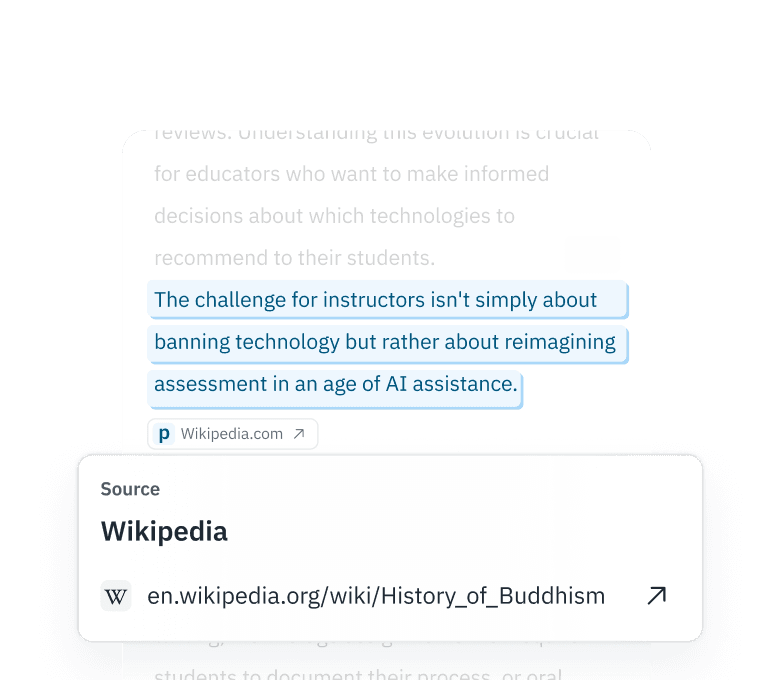
Plagiarism Checker
Catch traditional plagiarism alongside AI detection. Get source links and similarity scores in the same scan.
Integration
AI detection solutions
for teachers & schools

01
LMS Integration
Check assignments directly inside Canvas, Moodle, Google Classroom, and all web-based LMS systems. AI scores appear right in your grading workflow.
View Integrations →
02
Chrome Extension
Check student work in Google Docs, email, or any web-based platform without leaving your browser. One click to scan.
Get Extension →
03
API for Schools
Need to scan assignments at scale? Our API lets schools and districts integrate AI detection directly into their existing workflows and tools.
View API Docs →
Technical approach
Why teachers
trust Pangram
Pangram was built by AI researchers from Google, Tesla, and Stanford who published their detection methods openly. We prove the science behind the score.


Detects "Humanized" Essays
Students use paraphrasing tools and AI humanizers to disguise AI writing. Pangram's adversarial training catches these evasion attempts that fool other detectors.

Fair to ESL Students
Our models are proven unbiased against non-native English speakers. We detect AI based on linguistic generation patterns, not just writing quality or perplexity.

Privacy First (FERPA)
SOC 2 Type 2 certified and FERPA compliant. Student papers are never used to train models or shared across institutions. Your students' data stays yours.
By the numbers
AI in the classroom
of students admit to using some form of AI for assignments and essays, highlighting that AI is a classroom problem that is on the rise.
of teachers say that Pangram's detection is the most accurate.
of teachers recommend Pangram's transparency tool.
With a rise in AI-generated work from students, it's important to have an effective AI-detection tool capable of not just identifying whether AI is being used in work but also pinpointing the exact LLM that is being used, from Claude to GPT-4.
of teachers said that Pangram was able to facilitate better student-teacher conversations around AI use, leading to an overall increase in AI literacy.
Teachers are here to stay.
But so is AI.
Click to openA Note to Teachers from the Founders
More than four in ten K-12 teachers in the U.S. (44%) say that 90% of students are using AI for assignments.
At the heart of teaching is interacting with a child to help them grow and learn – a task that takes in many challenges, complexities, and demands.
Now with AI, there is an added layer of complexity for teachers to handle, as students inevitably use AI in the classroom. This cannot be changed or reversed. But what does this mean for teachers? In this new world, teachers will need to know how much thinking came from the student and to what extent AI was used.
That's why we created Pangram. Pangram empowers teachers to improve writing and promote critical thinking in an AI world without adding extra burden to teachers. Now teachers can adapt to this new world, verifying authorship, making decisions quicker, and having the right conversations with students.
Pangram has been verified as the world's best-in-class detection technology with the highest accuracy by third parties. It was built by AI researchers from Stanford, Google, and Tesla who love AI, but whose mission is to make AI for good and to keep the world and humans benefiting from this new technology.
Allowing AI to dilute the critical thinking, reading, and writing skills of students is not an option. We also believe in keeping our methods open and sharing with the world, so much so that we open-sourced our research methods on how we reached such high accuracy levels in our technical report. We're here to empower teachers so they can spend less time checking for AI and more time doing what they love – actually teaching!
Teachers love Pangram
FAQs
AI Detection FAQs
Looking for answers? Explore common questions
and get the information you need, all in one place.
Explore more
AI detection for
every organization
For Universities
AI detection for universities and higher education. Verify student assignments, screen research submissions, and protect institutional reputation.
Learn more →For Publishing & Media
AI detection for publishers and editorial teams. Protect editorial integrity and verify content authenticity at scale with the lowest false positive rate.
Learn more →For Content Moderation
AI content moderation for trust and safety teams. Detect AI-generated reviews, fake comments, and synthetic content at scale via API.
Learn more →