Cheating is rarely as simple as a student copying and pasting a whole Wikipedia article. Students are using more sophisticated methods to disguise unoriginal work.
The rise of Large Language Models, like ChatGPT, has supercharged a form of academic dishonesty known as “patchwork plagiarism.” Patchwork plagiarism, when conducted with AI, confuses standard grading tools and makes it more difficult for educators to properly assess their students’ work.
This guide defines “patchwork plagiarism,” explains how AI has complicated patchwork plagiarism, and shows how educators can use combined AI and plagiarism checkers to unpack complex document authorship.
What is Patchwork Plagiarism?
Patchwork plagiarism is the act of stitching together different phrases, ideas, and passages that originate from multiple sources - often with light paraphrasing or the swapping of synonyms - and then presenting them as a new, original work without any form of proper citation.
 AI Plagiarism Detection
Unintentional patchwork plagiarism is possible through poor note-taking and failing to acknowledge the source of certain claims. But, more often than not, patchwork plagiarism is used intentionally, in order to evade traditional plagiarism scanners that look for long, continuous blocks of copied text.
Academic documents produced through patchwork plagiarism tend to look like “Frankenstein documents.” They often possess varying tones and vocabularies that do not flow. Sometimes, they are incoherent on a structural level, even if the text itself makes perfect sense. Patchwork plagiarism is sometimes called “hybrid plagiarism.”
The "Hybrid" Threat: How AI Supercharges Patchwork Plagiarism
Generative AI has modernized patchwork plagiarism by allowing students to do two things: instantly stitch together human-written sources with AI-generated paragraphs and/or paraphrase large bodies of stolen text in a way that makes the text look original.
The LLMs people rely on are trained on massive datasets and, because of this, they can sometimes reproduce copyrighted material, phrasing, or a direct copy of someone else’s work. When a student submits AI-generated work, there is a chance they are actually turning in plagiarized human work.
 Pangram's AI Plagiarism Detector
To engage in patchwork plagiarism, students often take copied text and run it through an AI paraphrase. Doing so allows the AI paraphraser to swap synonyms in the copied text, making it very hard for a conventional plagiarism detector to detect.
AI Essay Checker vs. Plagiarism Checker: What’s the Difference?
A plagiarism checker scans the internet and proprietary databases to find direct, word-for-word matches of existing text. An AI checker analyzes the statistical predictability and syntax patterns of a particular text to see if it was generated with AI.
Standard plagiarism checkers like TurnItIn will miss new AI content because this content does not exist anywhere on the Internet, which means there is no source to match this content against. On the other hand, a standard AI detector will not catch a student who manually copies and pastes from an obscure academic textbook.
When it comes to an AI essay checker vs. a plagiarism checker, the answer is as follows: to catch modern patchwork plagiarism, educators need a consolidated tool that checks for database matches in order to detect conventional plagiarism while also checking for AI linguistic patterns that suggest a piece of text was generated with AI.
Can AI Detectors Catch Patchwork Plagiarism?
The answer to this question is “Yes.” You can use AI detectors to catch patchwork plagiarism. But, not every AI detector can be an AI plagiarism checker or detect paraphrased AI: you need an advanced platform, like Pangram, that combines cutting-edge AI detection with comprehensive plagiarism scanning in a single dashboard.
To detect patchwork plagiarism, Pangram uses “Segment Analysis.” Segment Analysis breaks down complex documents segment-by-segment and, in doing so, shows exactly which sentences were written by a person, which sentences were copied from an external source - and, it links the source - and which were generated by an LLM.
Outside of breaking down the exact segments of text within a document, Pangram 3.0 can even identify the spectrum of editing. This lets you distinguish whether or not a sentence is “Fully Human,” “Lightly AI-Assisted,” or “Fully AI-generated.” This feature makes Pangram 3.0 uniquely suited to untangle patchwork essays.
Best Practices for Handling "Mixed" Authorship
If an essay is flagged for patchwork plagiarism or mixed AI use, educators should use the detailed Pangram scan report as a diagnostic tool. Use the diagnosis to facilitate a conversation with the student about proper citation and finding their authentic voice as a student/writer.
Even though it may be tempting, the “cop” mentality is rarely advice. Use the granular breakdown, provided by Pangram, to show students where their work crossed the line from “using AI for a grammar check” into “outsourcing the writing.”
Regardless of the above, there is one more thing to remember: free, basic AI checkers are prone to false positives. If you use one, and it says that a work was AI-generated, there’s a chance this assessment is wrong. You may want to use an enterprise-grade tool with a near-zero false positive rate, like Pangram, before making academic accusations.
Patchwork plagiarism is no longer about mixing different library books together or compiling bits and pieces from disparate Wikipedia pages; it’s about blurring the lines between human thought, copied IP, and machine generation.
By utilizing a combined AI and plagiarism checker, educators can confidently assess student work to ensure authentic learning is taking place, as opposed to AI-fueled memorization, plagiarism, and copying/pasting.
Get the complete picture of text authenticity. Check for both AI and plagiarism all at once with one click:

Alex Roitman is Head of Growth at Pangram Labs, an AI content detection company. His work focuses on how AI-generated text is reshaping writing, education, and trust in the open web.
Related reading
How do AI Humanizers work?
Why Recruiters Need AI Detection
Useful AI policies for educators

Top 5 Enterprise AI Detector Features for IT Admins
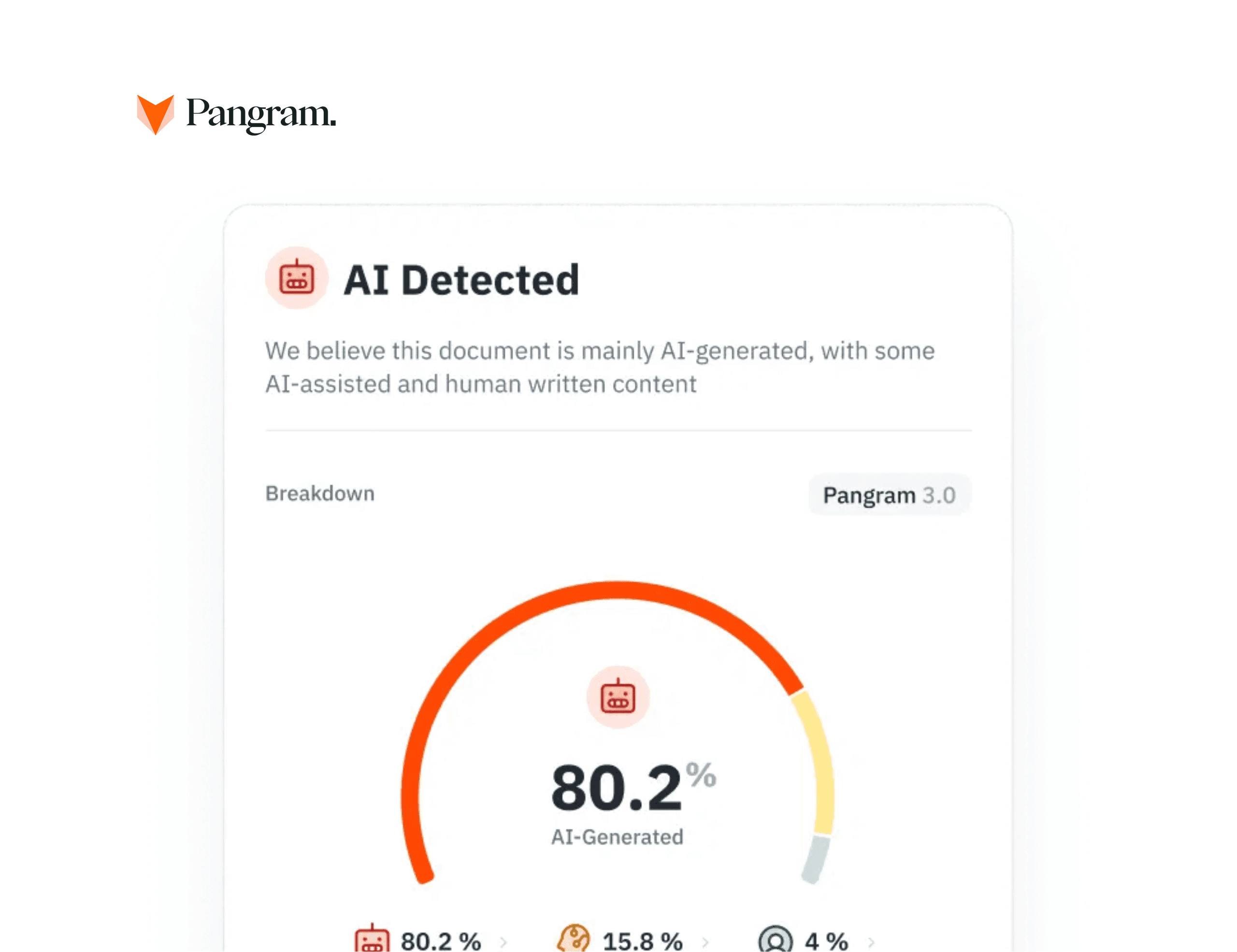
What does your AI detection score mean?
A trusted proofreading tool now uses AI to write for students