

AI detection for higher education
Uphold academic standards with the most accurate AI detection for higher education. See AI use transparently, screen research submissions, and protect institutional reputation with 99.98% accuracy.


经马里兰大学、芝加哥大学等第三方机构验证,本产品是市场上最可靠、最精准的人工智能检测工具。


Academic integrity
Prevent AI-generated "slop" from infiltrating peer reviews and grant applications. Our models identify AI even in complex, technical academic writing.
Avoid bias against non-native speakers. Pangram is proven to detect AI based on linguistic patterns, not just perplexity, protecting ESL students from false accusations.
Fully FERPA and SOC 2 Type 2 compliant. We never train our models on your student papers or proprietary research data.
集成
功能
采用经过多年研发的专有技术,而非开源模式或披着品牌外衣的商业大型语言模型。
Pangram依托多样化数据集、硬负样本挖掘和主动学习技术,实现了业界领先的假阳性率(FPR),而非依赖于在实践中常失效的熵值和突发性指标。
Pangram能够检测所有主流语言模型(包括ChatGPT、Claude、Gemini、Llama等)生成的内容,使其成为全面的人工智能检测解决方案。
Our AI detection works across more than 20 languages, making it a truly global, multilingual solution for institutions and businesses worldwide.
独立研究表明,Pangram的人工智能检测技术在识别AI生成内容方面优于经过训练的人类读者。
Pangram能够检测到经过"人性化处理"或被试图规避AI检测的工具处理过的AI生成的文本,从而确保检测的可靠性。
我们的准确性和可靠性已通过第三方研究机构和教育机构的独立验证。

Screen personal statements to ensure applicants are admitted on their own merit. Detect AI-generated application essays and personal statements before they influence admissions decisions.
Check essays and coding assignments with syntax-aware detection. Pangram's granular analysis distinguishes between fully AI-generated work and AI-assisted writing, enabling fair and nuanced assessment.
Verify the authenticity of peer reviews and funding applications. Ensure research integrity across your institution by detecting AI-generated content in grant proposals, literature reviews, and academic publications.
Our models are trained on academic-style writing and coursework, not just marketing or web content. This reduces false positives for legitimate student writing while maintaining high sensitivity to AI-generated text. See how teachers use Pangram for assignment verification.
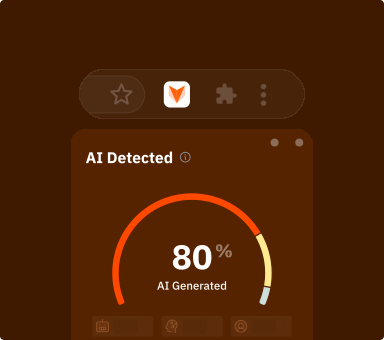
We provide granular, sentence- and paragraph-level highlighting that distinguishes AI-generated sections from human-written text. This allows faculty to make nuanced judgments rather than relying on binary pass/fail determinations, especially important for multi-chapter academic work.
Yes. Pangram supports detection across technical, analytical, and narrative writing styles, making it suitable for everything from lab reports and coding assignments to essays, literature reviews, and policy papers.
Yes. Pangram adheres to FERPA-aligned data privacy and handling standards required by U.S. educational institutions. Student submissions are processed securely and are not used to train external models.
Universities can configure data retention policies based on institutional requirements. Data can be automatically deleted after analysis or retained for audit and academic integrity review workflows.
Yes. Many institutions use Pangram not only for detection, but also to operationalize AI policies by defining acceptable vs. unacceptable use cases and applying consistent review standards across departments.
No. Pangram is designed as a decision-support tool, not an enforcement mechanism. Results are presented with confidence scores and explanations so faculty and academic integrity committees can make informed determinations.
Yes. Many universities use our high-throughput API to analyze AI usage trends across large datasets, enabling research into academic integrity, AI adoption patterns, and pedagogical impact.
Yes. Administrators can aggregate anonymized insights across courses, departments, or semesters to understand how generative AI is affecting learning outcomes and assessment strategies.
Pangram supports integrations and workflows compatible with common LMS environments including Canvas, Blackboard, Moodle, and Brightspace, making it easy to incorporate AI detection into existing assignment submission and review processes.
Yes. Many institutions choose to share detection insights with students as part of an educational or corrective process, helping reinforce responsible AI usage rather than relying solely on punitive measures.
The system emphasizes explainability and transparency. Highlighted sections, confidence scoring, and contextual signals help reduce over-reliance on a single metric and support fair academic review.
Explore more
AI detection for teachers and educators. Verify student authorship with 99.98% accuracy and catch AI-generated essays, paraphrased content, and humanizer tools.
Learn more →AI detection for law firms and legal professionals. Detect AI-generated briefs, verify legal citations, and ensure authentic authorship in every filing.
Learn more →AI code detection for developers and engineering teams. Detect AI-generated code from ChatGPT, Copilot, and Claude in Python, Java, C++, and more.
Learn more →Protect research integrity, ensure fairness for all students, and deploy AI detection campus-wide.